
Easy German Texts for Beginners (A1) + English Translation
November 28, 2026
If you are just starting to learn German, the hardest part is often finding something to read that you can actually understand. Textbook dialogues feel stiff, and real newspapers are far too difficult. What you need are easy German texts for beginners: short, written in simple present tense, and built from words you will meet again and again.
Below you will find five A1 texts with English translations, a short vocabulary list, and a few grammar patterns to notice. After that, you will see a simple four-step method to get the most out of any German text, and how to keep going with fresh material every day.
What does "A1" mean for a German text?
A1 is the first level of the Common European Framework of Reference (CEFR), the scale used for most German courses and exams. A text at this level typically has:
- very short sentences (often five to eight words)
- mostly the present tense
- everyday topics such as family, food, work, the weather and shopping
- words you can use right away, with few idioms and almost no complicated grammar
You do not need to understand every single word. At A1, understanding the main idea is a real success.
Text 1: Introducing yourself
Mein Name ist Anna
Hallo! Ich heiße Anna. Ich bin 28 Jahre alt. Ich komme aus Spanien, aber ich wohne in Berlin. Ich arbeite in einem Café. Am Wochenende lerne ich Deutsch. Ich mag Kaffee, Musik und Bücher.
Translation: Hello! My name is Anna. I am 28 years old. I come from Spain, but I live in Berlin. I work in a café. At the weekend I learn German. I like coffee, music and books.
Notice: In a normal German statement the verb is always in second position: Ich heiße Anna. / Am Wochenende lerne ich Deutsch. When you start with "Am Wochenende", the verb still stays second, so "ich" moves behind it.
Text 2: A normal morning
Mein Morgen
Es ist sieben Uhr. Ich stehe auf und trinke Kaffee. Ich esse ein Brötchen mit Käse. Um acht Uhr gehe ich zur Arbeit. Ich fahre mit dem Bus. Abends koche ich Suppe und sehe einen Film.
Translation: It is seven o'clock. I get up and drink coffee. I eat a bread roll with cheese. At eight o'clock I go to work. I take the bus. In the evening I cook soup and watch a film.
Notice: aufstehen (to get up) is a separable verb. In the sentence the prefix jumps to the end: Ich stehe ... auf. You will meet many verbs like this, for example einkaufen (to shop) and anrufen (to call).
Text 3: At the supermarket
Im Supermarkt
Heute gehe ich in den Supermarkt. Ich brauche Milch, Brot und Äpfel. Die Äpfel sind heute nicht billig. Ein Kilo kostet drei Euro. Ich kaufe nur ein halbes Kilo. An der Kasse sagt die Kassiererin: „Das macht fünf Euro zwanzig.“ Ich bezahle mit Karte und sage: „Danke, schönen Tag noch!“
Translation: Today I go to the supermarket. I need milk, bread and apples. The apples are not cheap today. One kilo costs three euros. I only buy half a kilo. At the checkout the cashier says: "That comes to five euros twenty." I pay by card and say: "Thank you, have a nice day!"
Notice: in den Supermarkt answers the question "where to?" and uses the accusative (der Supermarkt becomes den Supermarkt). You do not need the full case system yet. Just collect fixed chunks like in den Supermarkt gehen and mit Karte bezahlen.
Text 4: A sunny Saturday
Ein Tag im Park
Heute ist Samstag. Das Wetter ist schön. Die Sonne scheint, und es sind 22 Grad. Wir gehen in den Park. Meine Freundin hat einen Hund. Er heißt Max. Wir spielen mit dem Ball und essen ein Eis. Am Abend sind wir müde, aber glücklich.
Translation: Today is Saturday. The weather is nice. The sun is shining and it is 22 degrees. We go to the park. My friend has a dog. His name is Max. We play with the ball and eat an ice cream. In the evening we are tired but happy.
Notice: Meine Freundin hat einen Hund. After haben the thing you have is in the accusative, and for masculine nouns ein becomes einen. Compare: Das ist ein Hund. (no accusative after sein).
Text 5: A short news-style text
Mehr Fahrradwege
In vielen deutschen Städten gibt es jetzt mehr Fahrradwege. Immer mehr Menschen fahren mit dem Fahrrad zur Arbeit. Das ist gut für die Umwelt, und es ist billig. Aber nicht alle sind froh: Autofahrer haben weniger Platz.
Translation: In many German cities there are now more bike lanes. More and more people ride their bike to work. That is good for the environment, and it is cheap. But not everyone is happy: drivers have less space.
This is an example text written in the style of a news item, not a real report. It shows how even a "news" topic can be told in plain A1 German: short sentences, common words, one idea at a time. Reading real topics like this is the fastest way to move beyond made-up textbook scenes.
Key words from these texts
Always learn German nouns with their article (der, die, das). Guessing the gender later is much harder than learning it together with the word.
| German | English | Plural |
|---|---|---|
| das Brötchen | bread roll | die Brötchen |
| der Käse | cheese | (no plural) |
| die Suppe | soup | die Suppen |
| der Film | film | die Filme |
| der Apfel | apple | die Äpfel |
| das Brot | bread | die Brote |
| der Supermarkt | supermarket | die Supermärkte |
| die Kasse | checkout | die Kassen |
| der Park | park | die Parks |
| der Hund | dog | die Hunde |
| das Fahrrad | bicycle | die Fahrräder |
| der Platz | space, place | die Plätze |
| die Umwelt | environment | (no plural) |
And a handful of useful verbs: heißen (to be called), wohnen (to live), arbeiten (to work), kaufen (to buy), brauchen (to need), bezahlen (to pay).
A four-step method for any German text
Reading a text once and moving on teaches you very little. Try this routine instead. It takes about ten minutes per text:
- Read for the gist. Read the whole text without stopping. Ask yourself only: who, what, where?
- Read again and mark 3 to 5 unknown words. Do not look up everything. Pick the words that appear to matter most for the story.
- Check the meaning in context. Look at the full sentence, not only the single word. A word in a sentence is much easier to remember than a word on a list.
- Read it aloud once. Saying the sentences out loud helps your memory and your pronunciation, even if you are alone.
Then, a day later, read the same text again. The second reading will feel surprisingly easy, and that feeling is exactly what builds confidence.
Where to find more easy German texts
Five texts are a good start, but beginners need a lot more reading to build a basic vocabulary. The problem with printed A1 books and PDFs is that they run out, and the topics rarely change.
This is the idea behind Newslang: instead of fixed textbook passages, you read real articles that are adapted to your level. In the app you can:
- choose your CEFR level: the same article is available at A1, A2, B1 and B2, so you can start easy and switch to a harder version later
- tap any word to see its translation, the sentence translated into English, an example sentence and audio of the pronunciation
- save words to your dictionary and practise them with flashcards, matching pairs, listening and other exercises
- listen to the audio while you read along, which trains your ear and your reading together

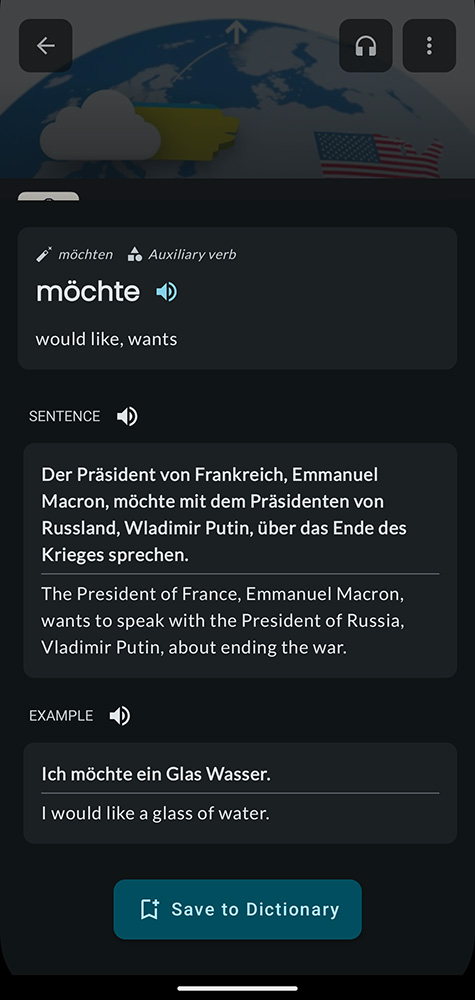
Newslang also includes guided voice lessons for speaking practice, so you can say the phrases you have just read. If you want to try it, there is a page that shows what A1 articles look like: easy German news for beginners. You can also browse a few German articles on the Newslang articles page.
FAQ
How many words do I need for A1 German? Different courses give different numbers, but a rough figure is around 500 to 1,000 words. Do not worry about the exact count. If you can read the texts above with a bit of help, you are at the right level.
Should I read with or without a translation? Start with the translation hidden. Try to understand the gist first, then check. If you read the translation first, your brain does not have to do the work, and learning is much slower.
Is it okay to use a dictionary or tap-to-translate while reading? Yes, as long as you do not translate every word. Look up only the words that block your understanding of the sentence, and write the new words down together with the article.
How often should I read? A short text every day beats a long session once a week. Ten to fifteen minutes is enough to see progress within a few weeks.
When should I move on to A2? When you can read an A1 text from start to finish and understand most of it without checking a translation. In Newslang you can simply switch the same article to the next level when you feel ready.
Ready for your next German text?
Re-read the five texts above, pick the five words you liked most, and write one sentence with each of them. Then open an article in the app and try it with a real topic at A1. It is free to start on the web and on iPhone and Android.